

Our client, a startup at the European Space Agency's Business Incubation Centre, came to us with a familiar software problem in an unfamiliar domain. Their users design CubeSats (small, shoebox-sized satellites that are far cheaper and faster to build than traditional ones), but they were doing it with a patchwork of disconnected desktop tools, spreadsheets, and one-off scripts. There was no single place to plan a project, run the heavy calculations behind it, share results with teammates, or visualise the outcome. The challenge handed to us was a classic SaaS one: take a fragmented, expert-only desktop workflow and turn it into a unified, multi-user, browser-based product. It had to render complex 3D scenes smoothly on any modern laptop, run computationally heavy simulations on demand, store and version users' projects safely in the cloud, and scale gracefully as the customer base grew, all without sacrificing the numerical precision the work demands.
Building a Cloud SaaS Platform for Satellite Mission Design
The Challenge

The Solution
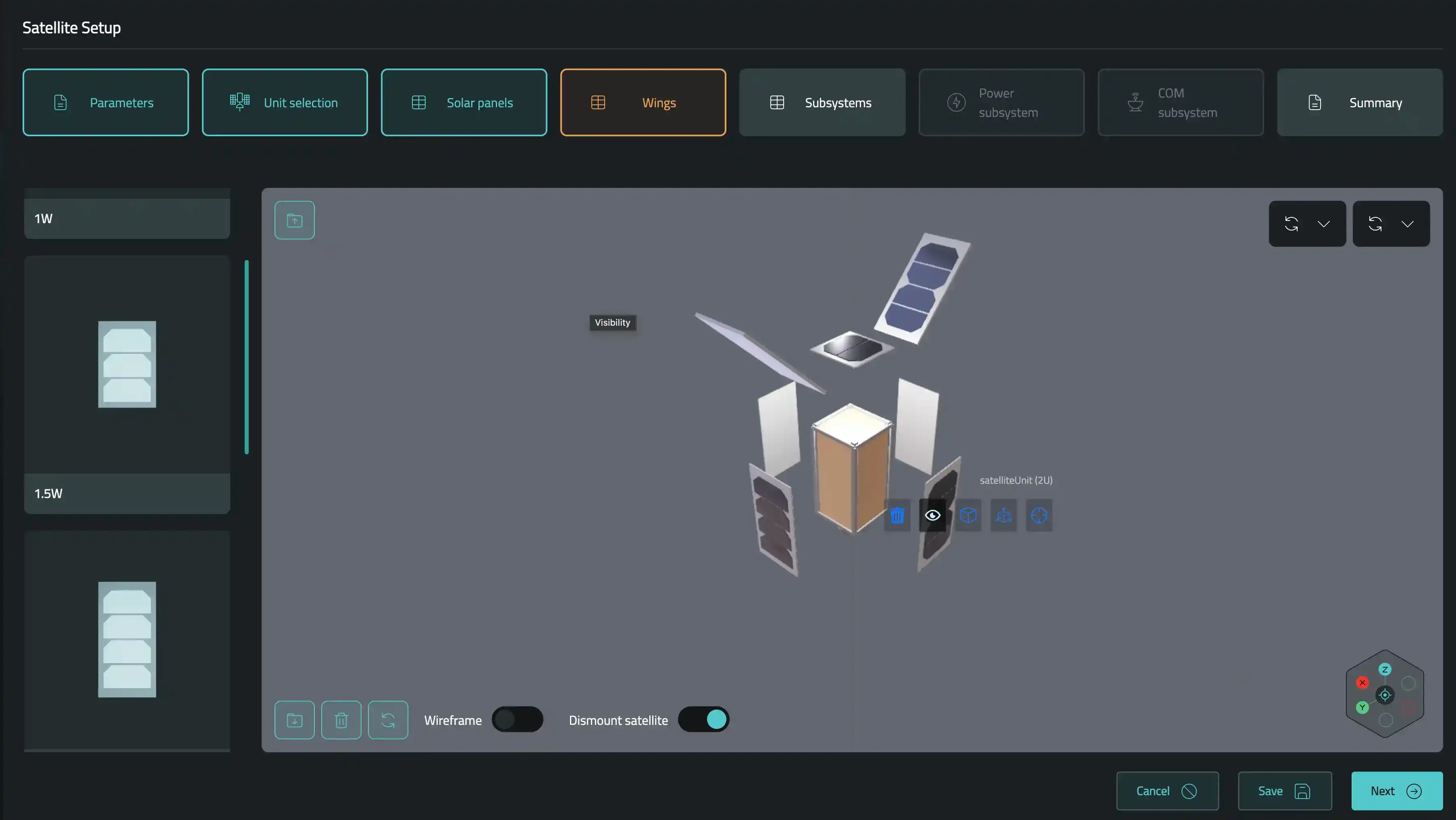
We designed and built SatZone as a full cloud-based SaaS product from the ground up. The frontend is a single-page React application that runs entirely in the browser, with Babylon.js powering interactive 3D visualisations, letting users see the path a satellite will take around Earth (its 'orbit') and how it lines up with ground stations, in real time and on any modern device. The backend is split into two layers: a Python service that handles user accounts, project data, APIs, and orchestration; and high-performance C++ modules that take on the heavy numerical work, such as calculating how much battery power a satellite will have at any moment, or how strong its radio link to the ground will be (engineers call these 'energy' and 'link budgets'). Everything sits on AWS, using managed services for compute, storage, authentication, databases, and auto-scaling, so the platform stays responsive whether one engineer or a hundred are logged in. The result is a multi-user web app where teams collaborate on shared projects in real time, with the performance, security, and reliability you'd expect from any modern SaaS product.

The Result
SatZone replaced a tangle of desktop tools with a single web platform that any team member can open in a browser and start working in immediately: no installation, no file syncing, no version conflicts. Design cycles that used to take weeks of back-and-forth now happen in a shared environment where changes are visible to everyone in real time. By moving the heavy lifting to the cloud, users no longer need powerful local machines, and the product can serve customers anywhere in the world with consistent performance. For our client, the project proved that a small startup can ship a polished, production-grade SaaS that competes with (and in many ways outperforms) the legacy desktop tools the industry has relied on for years. For us, it's a flagship example of how we combine modern web engineering, cloud infrastructure, and serious backend computation into a single, coherent product, regardless of the domain it serves.
Project tech stack


React


Babylon.js


Python


Amazon Web Services (AWS)


C++